


January for many means no booze, working out, new year’s resolutions, and freezing weather. However, in the hiring world, January is a complete boom season. The number of roles posted and hiring activity tend to spike up drastically, including for startups, and this year is no different.
TL;DR of this edition:
(1) Interesting reads of the week from across startups & tech
(2) What does semantic matching mean for resumes?
(3) Can marketplaces be more effective with AI?
(4) Relevant roles posted in the past week at startups for young candidates.
Interesting Links
1,197 dead startup ideas. A list of startups that died (mostly over the last decade) and burned over $44B?! VC dollars. One founder’s failure is another founder’s treasure. Loot the wreckage. The site even includes cause of death ☠️, current market, execution plan, and more. A few of my favorites:
TeeBeeDee (2007–2010): Tried to build a social network just for people over 40. Burned $9M. The idea itself is not crazy at all given an underserved demo with money, opinions, and time. The miss was timing + behavior. In 2007, this group just was not living online yet. Today? Much more interesting.
Onepagetrip (2016–2020): Centralized, community-generated travel itineraries. Trip planning still sucks, and even LLMs today are pretty lackluster at doing this well. Training data is mediocre (ex. TripAdvisor is mostly tourist traps). Prime for distribution through TikTok and Reels and could create an incredibly valuable data source of high-quality travel itineraries.
Theranos (2003–2018): Had to throw this one in. Could an improved AI model trained on existing diagnostic data enhance result accuracy?
1,136 fresh startup jobs posted in the last week. The roles specifically for young candidates are featured at the bottom of this newsletter!
Everyone Should Hear From You Once a Month. Alex Rampell (TrialPay founder, a16z partner) on early-stage sales: you can't force someone to buy until they're ready, so stay top-of-mind through monthly touchpoints (emails, visits, gifts). His secret to landing breakfast with PayPal's President? Sending gifts to Executive Assistants yearly. It might sound overboard, but small gifts with thoughtful sentiment (not high monetary value) to potential clients or employers can create outsized returns.
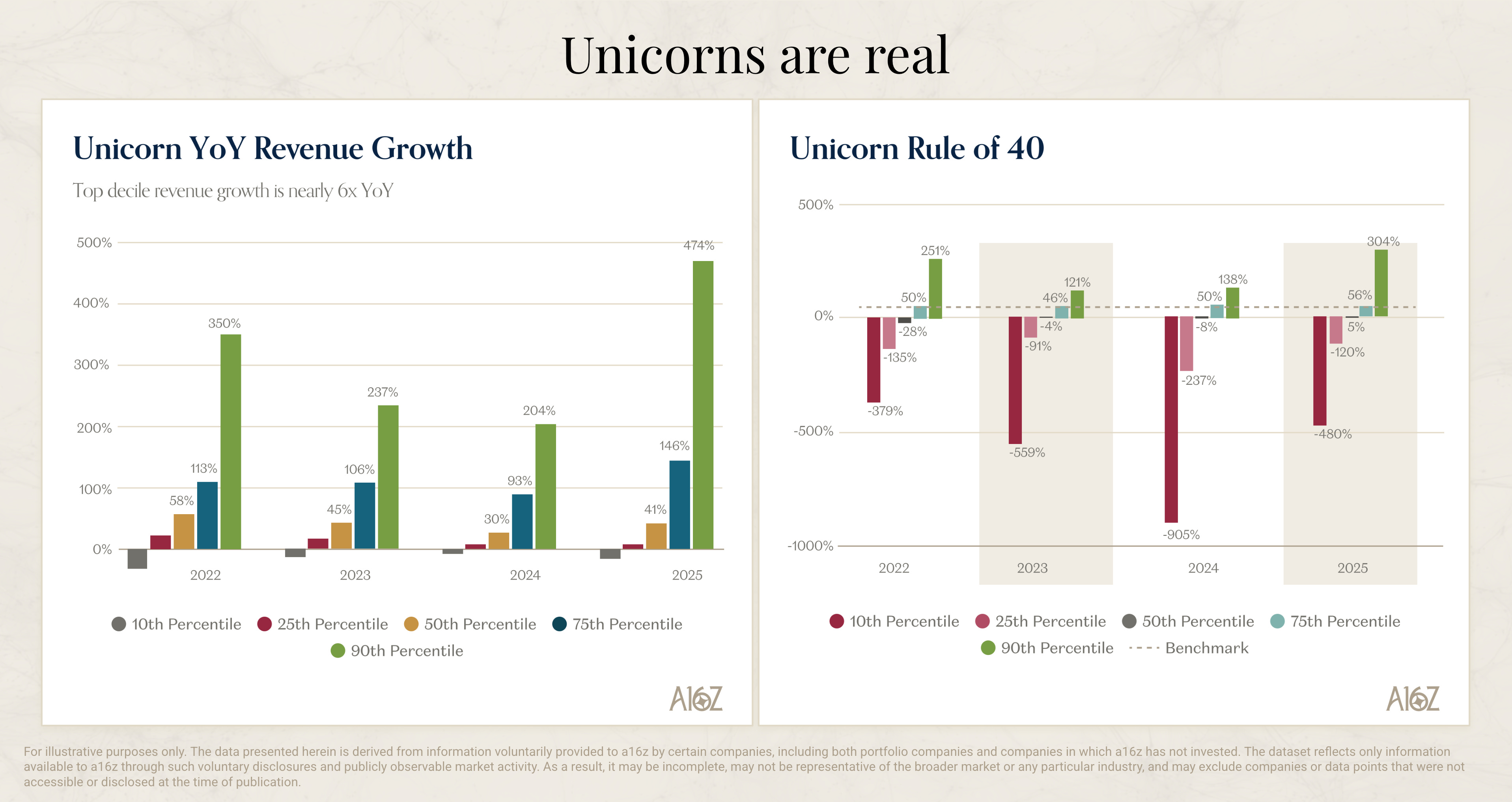
Winners Keep Winning. a16z's "State of Markets" deck shows 2025 revenue growth exploded for top quartile companies while lagging for everyone else. Venture is a power law business.
How to Teach Creators UGC. The founder of SideShift, a UGC creator marketplace, shared best practices, including shoot casual (not ad-like), use simple editing with clear hooks and captions, and focus on three formats: talking-to-camera, slideshows, or hook-and-demo.
Why Job Hopping Early Might Be Good. Harvard's Dark Horse Project studied 50 top performers and found 45 said "don't follow my path — I jumped around a lot." Turns out, this zigzagging approach may be ideal for success: learn what you're unexpectedly good at or interested in, pivot based on new self-knowledge, and repeat until you achieve strong "match quality" between your interests and abilities. Within reason, I think this is a sensible approach.
What Does Semantic Matching Mean for Resumes?
For years, resumes were sourced, parsed, and matched to job descriptions mostly off keywords. If you mentioned tools likely in the job description (HubSpot, Python, Salesforce), you were giving yourself a boost. Simple as that.
This is evolving. Many hiring processes are turning toward semantic matching techniques. At Teli Labs, we internally use semantic matching on embeddings from candidates and job descriptions. It's increasingly becoming the norm, though adoption is moving slowly in enterprise given legal restrictions on AI in hiring and concerns about algorithmic bias.
Though it’s a bit of a black hole, the core change is context over keywords. Modern recruiting platforms don't just search for "Python" anymore. They're searching for the mathematical proximity (in high-dimensional vector space) between your experience and their specific job description. As a result, "Python" + "machine learning" signals deeper experience than "Python" in isolation.
So, what seems to matter?
Formatting. No two-column layouts. Stick to basic fonts (serif or sans-serif). Avoid colors. Black text on white background. No highlighting. Use high-quality PDFs or .docx files, never scans. Include clear section titles (Experience, Education, Skills) for proper parsing.
Tool + Domain Context. Continuing the Python example, listing "HubSpot" without "email campaigns" or "lead enrichment" may read as surface-level. Pair tools with the domain concepts that define real work.
Explicit Industry Language. If you have experience in the exact industry of the job, make it explicit. Help the model understand context. One potential way to do this: in your first bullet for a given role or extracurricular, state clearly what the organization does (ex. "Led growth initiatives at fashion tech startup serving 50K users" instead of just "Led growth initiatives serving 50K users"). Or, include in the position title (ex. Marketing Intern at Fashion Tech startup).
Projects are increasingly valuable. They provide opportunities to demonstrate skills with context and outcomes. A detailed project description can match semantic signals as effectively as formal work experience.
Marketplaces and AI
Olivia Moore at a16z wrote a great piece two months ago about marketplaces in the age of AI. Her thesis: AI isn't opening up brand new categories. In her words, it's reviving ones where marketplaces previously failed, turning graveyards into greenfields.
Historically, marketplaces fail for two reasons:
CAC is too high. Matching requires too much coordination, trust-building, or human effort to convert users.
LTV is too low. Users churn quickly, transact infrequently, or margins are too thin to justify the cost of acquiring supply and demand.
AI can help alleviate both of these.
First, it collapses coordination costs.
Automated intake, voice-based onboarding, AI interviews, work simulations, credential verification, and background checks remove friction that once required humans. What used to take days or weeks can happen asynchronously and cheaply.
Second, it keeps both sides engaged.
AI enables persistent, personalized nudges. Candidates and employers can be reactivated with relevant recommendations, timing-aware outreach, and context-rich follow-ups. This materially increases repeat usage and lifetime value.
Third, it raises marketplace quality.
AI fundamentally improves matching. Better models create stronger first-order matches, and every downstream outcome — in talent marketplaces, interviews scheduled, offers extended, hires made, performance on the job, and early churn — generates feedback that can be utilized more powerfully than ever before to unlock second-order insights.
Fourth, data compounds into defensibility.
In the era of fast fashion SaaS, marketplaces accumulate clean, structured data on participants and outcomes.
The playbook is emerging, but outside of Mercor we have yet to see a true breakout, leaving open the question of which long-failed marketplaces are next to be revived.
Job RoundUp Highlights
Here are some jobs posted within the last week that are a great fit for recent grads, college students, and young candidates in large US cities, including (1) Growth, Sales, Marketing & Ops, (2) Engineering, (3) Design, Data, Legal, Finance & Admin Roles.
Growth, Sales, Marketing & Ops Roles
Sales Development & Business Development:
Business Development Representative (BDR) at SafetyKit (San Francisco)
Business Development Representative (BDR) at Prior Labs (New York)
Sales Development Representative (SDR) at Alex (San Francisco)
Sales Development Representative, Bengaluru at CodeRabbit (Bengaluru)
Sales Development Representative at Metaview (San Francisco)
Senior Sales Development Representative, SDR (Remote) at Nooks (United States)
Enterprise Sales Development Representative, SDR (Remote) at Nooks (United States)
Enterprise Sales Development Representative, SDR (Hybrid) at Nooks (San Francisco)
Founding Sales Development Representative at Tavily (Austin, Texas)
Founding Sales Development Representative at Tavily (New York City)
University Grad | Sales Development Representative at Ramp (New York, NY)
Sales Development Representative | Inbound at Ramp (New York, NY)
Sales Development Representative | Ontario, Canada at Ramp (Remote (Ontario, CA))
Partner Development Representative | ISV at Ramp (New York, NY)
Business Development Representative at Enterpret (New York (Hybrid))
Business Development Representative - Austin at Tiger Data (US Full-time)
Business Development Representative at Typeface (US Remote)
Partner Development Representative at Tabs (New York City, NY)
Sales Development Representative (SDR) - 2026 New Grads at Traba (New York City, NY)
Sales Development Representative (SDR) at Traba (New York City, NY)
Marketing & Content:
Short-Form Content Creator at Eleven Labs (United States)
Content and Social Manager at Pallet (San Francisco)
Copywriter at Crux (Remote (US))
Social & Content Marketer at Rox (San Francisco)
Builder - Content Marketing, Video at Reevo (San Francisco or Santa Clara)
Builder - Social Media Marketing at Reevo (San Francisco or Santa Clara)
Social Lead at Campfire (San Francisco)
Video Editor at Circle (Remote)
Content Marketing Manager at Range (McLean, VA)
Community Manager, Affiliates at Posh (New York City)
Operations & Coordination: