


Happy Sunday, and welcome to new readers since last week’s issue! Hope everybody is excited for the holiday season and taking some time today for themselves, to reset, and maybe explore a new hobby.
Echo Chamber of Your Awesomeness.
Sometimes people pull off things you thought were impossible, and it makes you pause and wonder… how??? What is your secret?? The people need to know!
One theory is incredibly powerful: creating an echo chamber of your awesomeness. Credit to Grace Gerwe for coining the term (highly recommend reading her insights on it!).
It may sound a bit ridiculous at first, but it can work wonders. Whenever you are applying for something or trying to raise money, you can ask several people you know (ideally mutuals) to send short, glowing notes about you to the decision-maker, investor, or whoever you want to influence.
Put yourself in the shoes of someone trying to make a hiring decision. You are choosing from, call it, 30 candidates. They are all highly qualified and there are a few who stand out slightly from the pack. Then one “middling” candidate gets a dozen people, or even just a few, to flood your inbox with glowing reviews. All of a sudden, most decision-makers will elevate that individual to the top of the pile and 10x their likelihood of selection.
For placement into a freshman year writing class at Harvard, they made all incoming students in my class write a paper on echo chambers. A key reading was John Stuart Mill’s On Liberty, where he argues that genuine understanding comes from hearing “what can be said about it by persons of every variety of opinion.”
Mill was focused on the pursuit of truth in society, but in competitive selection processes the goal isn’t philosophical debate. It’s differentiation. Strategically shaping your own narrative is often what separates you.
It takes effort to execute an echo chamber of your awesomeness, but it is extremely powerful. Not only is it useful to have references vouching for your ability, it is also a vivid way to highlight your agency.
Agency and initiative are increasingly valuable traits. Knowledge and intelligence are, in some ways, being democratized by AI tools. Agency endures as the major lever to differentiate yourself.
The most obvious application is getting a job. However, this mindset naturally translates to other domains in life as well. Joining a social club or organization. Convincing your landlord to choose you for a competitive apartment. Getting a potential child into a school or elite extracurricular program. Even with a potential romantic partner (the “echo chamber” execution here would definitely need to be much more delicate and informal).
In terms of putting this into practice, I want to try to hypothesize an example:
You are applying for a job. Reach out to someone you worked with in a prior role, someone you worked for or with for an extracurricular / project, or even your roommate. Say something like: “Hey, I am applying for X. Would you be comfortable sending a quick note or reference to Y? I am happy to send you a draft.” If they follow through, be sure to reciprocate and offer value back. You have to give to take.
Some Questions to Ponder On:
Think about something you will be applying to soon. How can you intentionally shape your narrative, and who could you ask to help create an echo chamber of your awesomeness?
What would you want a reference to say about you?
Who could you offer to vouch for? This could strengthen your connection with that person.
I would be remiss not to acknowledge a few caveats: (1) Every situation is different, so you have to assess whether this approach is appropriate. Sometimes it is not. (2) This strategy may rub some people the wrong way, but my view is that you only need one job and it is impossible to make everyone happy. (3) Make sure any notes sent on your behalf reflect genuine advocacy based on real work you have done, not spammy or fabricated social proof. (4) Be selective about who you tap in your network and avoid over-using your connections. Always offer to reciprocate.
5 Tweets of the Week

Many were criticizing YC for backing this “brainrot code editor,” most notably Jordi Hays, who argued that the whole launch was essentially rage-bait disguised as a product. He broke down how making people mad has become a repeatable engagement loop, not a sign of real traction. Garry Tan replied acknowledging that Hays had good points.
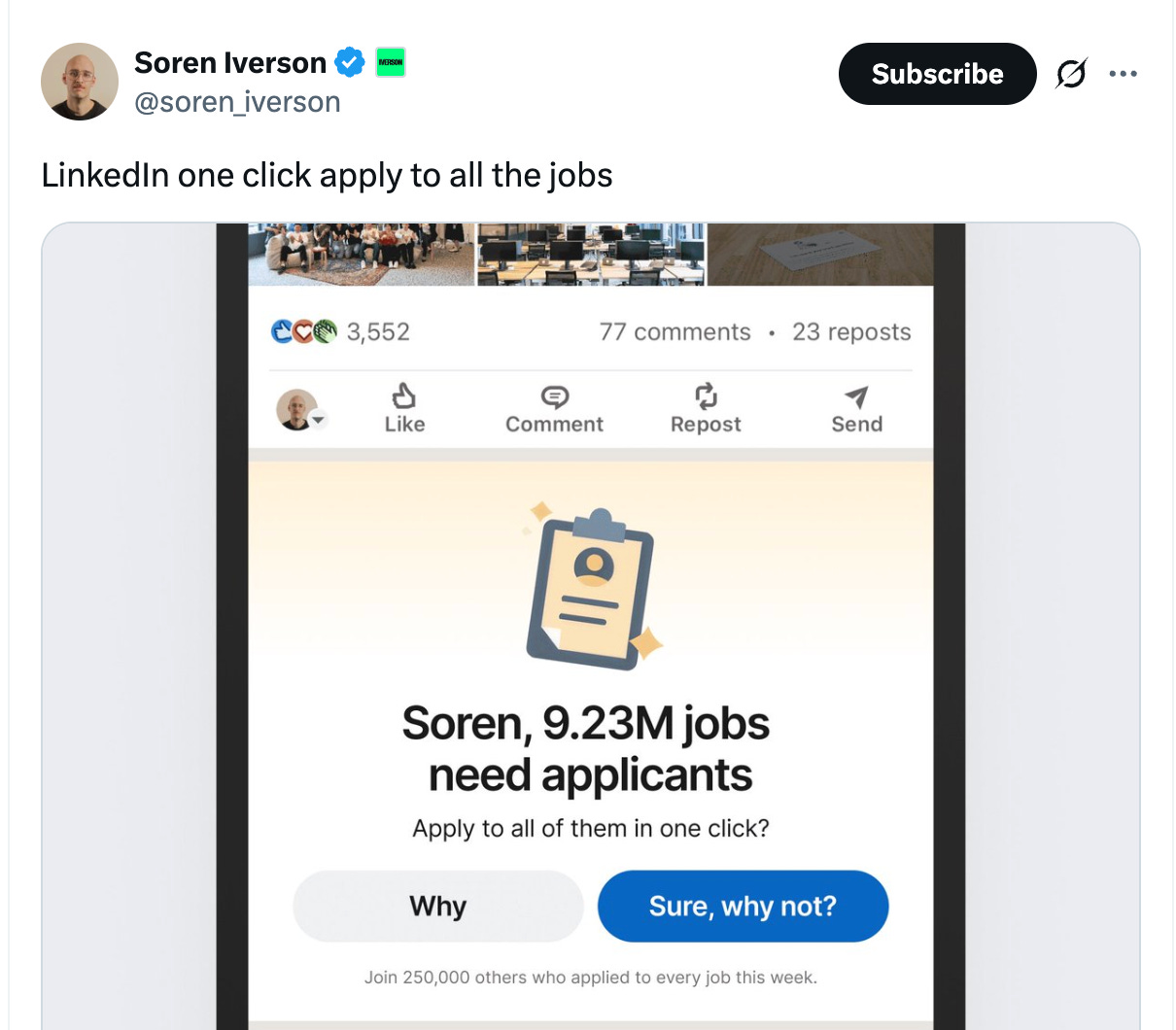
What have we come to? What is the point of applications if everyone is applying to everything? I’m bullish on employer-pull and outbound hiring (where companies reach out to candidates rather than candidates spending hours mindlessly submitting applications).
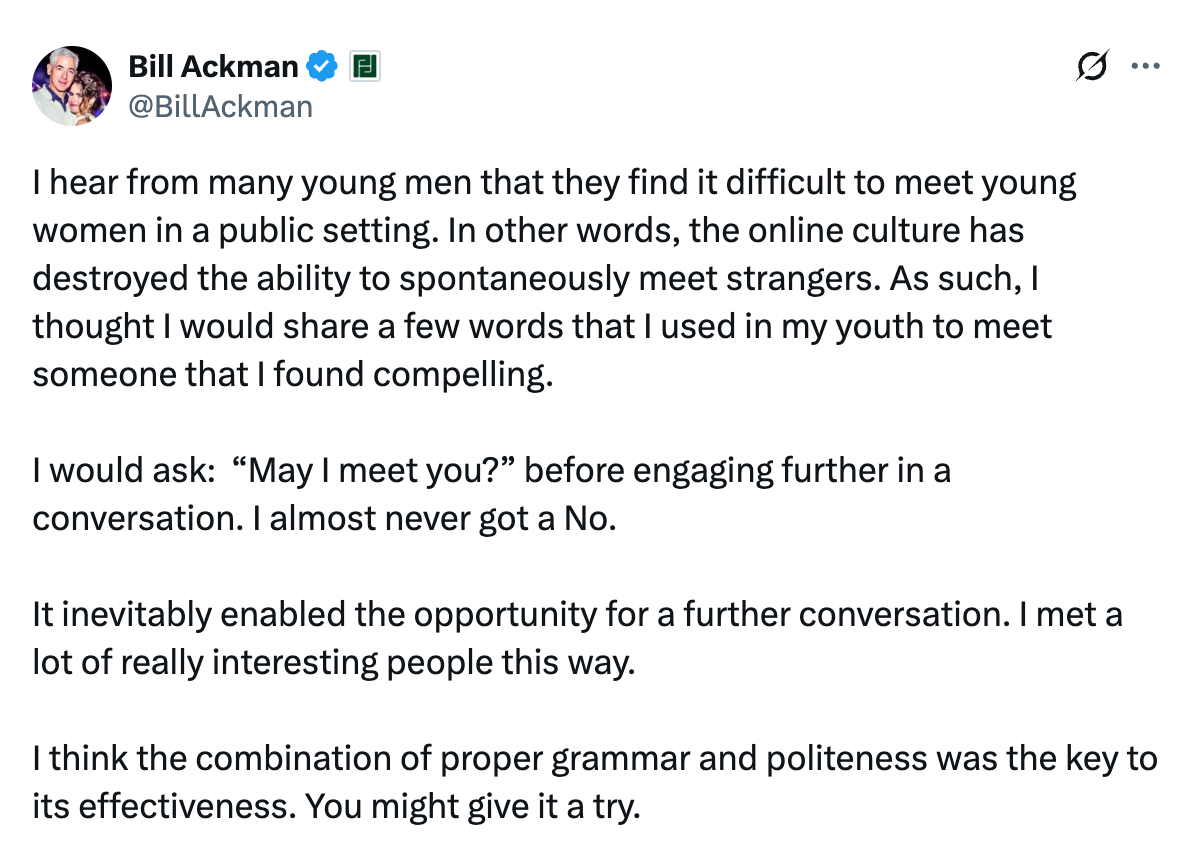
Ah yes, the great pickup line: “May I meet you?” It’s the “proper grammar” that really does it.
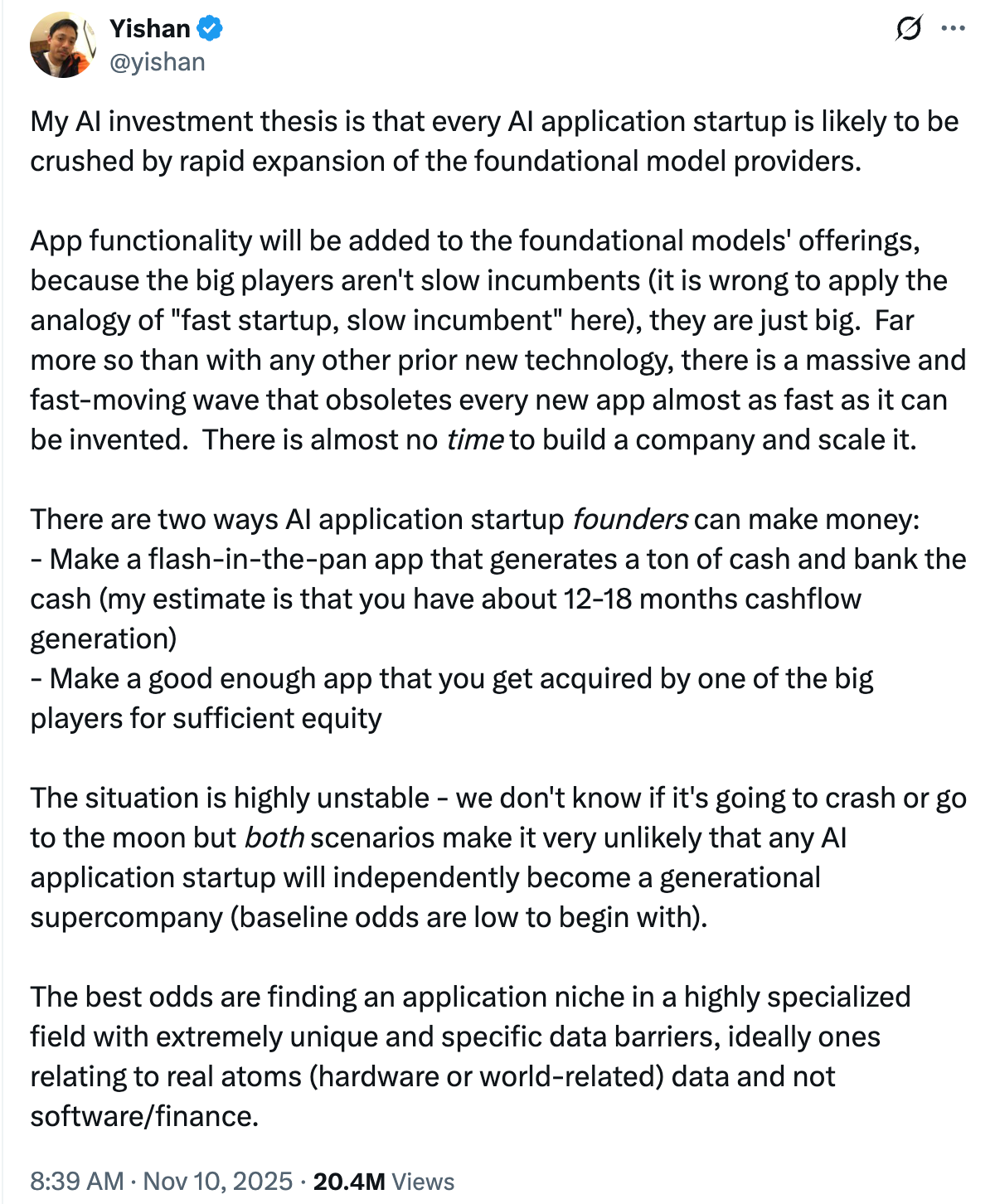
This post sparked debate, with investors arguing that labs are too focused on core model scaling to wipe out the whole app layer, that vertical AI with strong workflows or real-world complexity can still build defensible products, and that founders should focus on sticky integrations and realistic cash-flow / acquisition outcomes instead of chasing unicorns.

Thank you for reading!!
If you have any feedback or recommendations, don’t hesitate to reach out to me at adrian@telilabs.com. Have a great week!