


TL;DR of this edition:
(1) Why your digital footprint is becoming your real resume.
(2) Tom Orbach’s best marketing ideas for starting from zero.
(3) ChatGPT’s retention curve isn’t as unprecedented as Garry Tan thinks.
(4) Independent media is ready to be re-bundled into VC-scale businesses.
(5) Scott Galloway on AI backlash, media fragmentation, and young founders.
(6) Prediction markets are a regulatory arbitrage play dressed up as financial innovation.
1) Personal SEO and Employer Pull Hiring
Let me outline 2 scenarios:
Scenario #1: Soliciting and sorting through applications is expensive. AI hiring tools get incredibly good and cheap to build in-house (outside of regulated functions like background checks and payroll compliance). Companies start using AI to proactively source candidates from LinkedIn, their networks, and the broader internet. The job application slowly disappears as discovery is no longer the bottleneck.
Scenario #2: Traditional applications still exist, but before making a hiring decision, the company runs an AI agent that scrapes your resume, socials, posts, news articles, and anywhere else you appear online. It compiles a full report before a human ever looks at your application.
Both scenarios are realistic directions for startup hiring. And in both, the key thing for candidates to consider is their digital footprint. In the same way companies think about SEO, you should start thinking about your own personal SEO. When your online presence gets scraped, how do you show up? Would your profile be a strong fit for your dream job?
A few thoughts:
Think about what AI sourcing tools already use to elevate profiles:
Profile richness (LinkedIn descriptions, skills, about)
Recency (how recently you've posted or engaged)
Lookalike modeling. Companies find a great employee and use AI hiring tools to search for more people like them. Makes sense from a company perspective, but it boxes candidates into certain paths. You might get penalized for a non-linear career, not attending a similar school, or deeper (and more problematic) biases the model internalizes.
Increase your digital footprint. Posts and articles where you're mentioned tend to be beneficial. You only need one company to hire you, not the whole world to love you. Post your thoughts and experiences (within reason obviously).
Personal website. Opportunity to shape your narrative and doesn’t cost much. Use Claude to build it, ~$10/year for a domain, free hosting on Cloudflare/Vercel.
Cross-link everything. LinkedIn, GitHub, personal website. Make sure they all point to each other.
2) Favorite Marketing Swipe File Ideas
Tom Orbach (CMO of Wiz) writes the best marketing newsletter out there. A few of my favorite ideas from him in recent weeks:
On starting a company from zero:
Start with 20-50 insiders. Before you do anything public, make a private WhatsApp or Telegram group with friends, former colleagues, early believers. Give them early access, behind-the-scenes, direct line to the founders. This cohort can be super powerful to even do basic tasks such as liking and commenting on your LinkedIn posts to boost visibility.
Pick an enemy. It’s rarely a competitor. It’s something deeper your customers already hate but no one says out loud.
Make the founder famous. Post 3-4x/week on LinkedIn. Then boost what performs with Thought Leader Ads.
Fish where the fish are. Your customers are already gathered somewhere. Newsletters, podcasts, Slack groups, subreddits.
On doing marketing efficiently:
Grok Automated Tasks. I set this up a few weeks ago for myself (took <10 min), and I get an email every morning with the posts gaining the most traction from top VCs and tech CEOs. ChatGPT has tasks too but without the X integration it can’t see what’s actually trending on social.
Reddit Answers. Tom comments in subreddits to get real answers on his questions within minutes. Good for finding what tools people use, what frustrates them, and what’s working.
3) Inflecting Retention Curves Are Table Stakes in Consumer AI
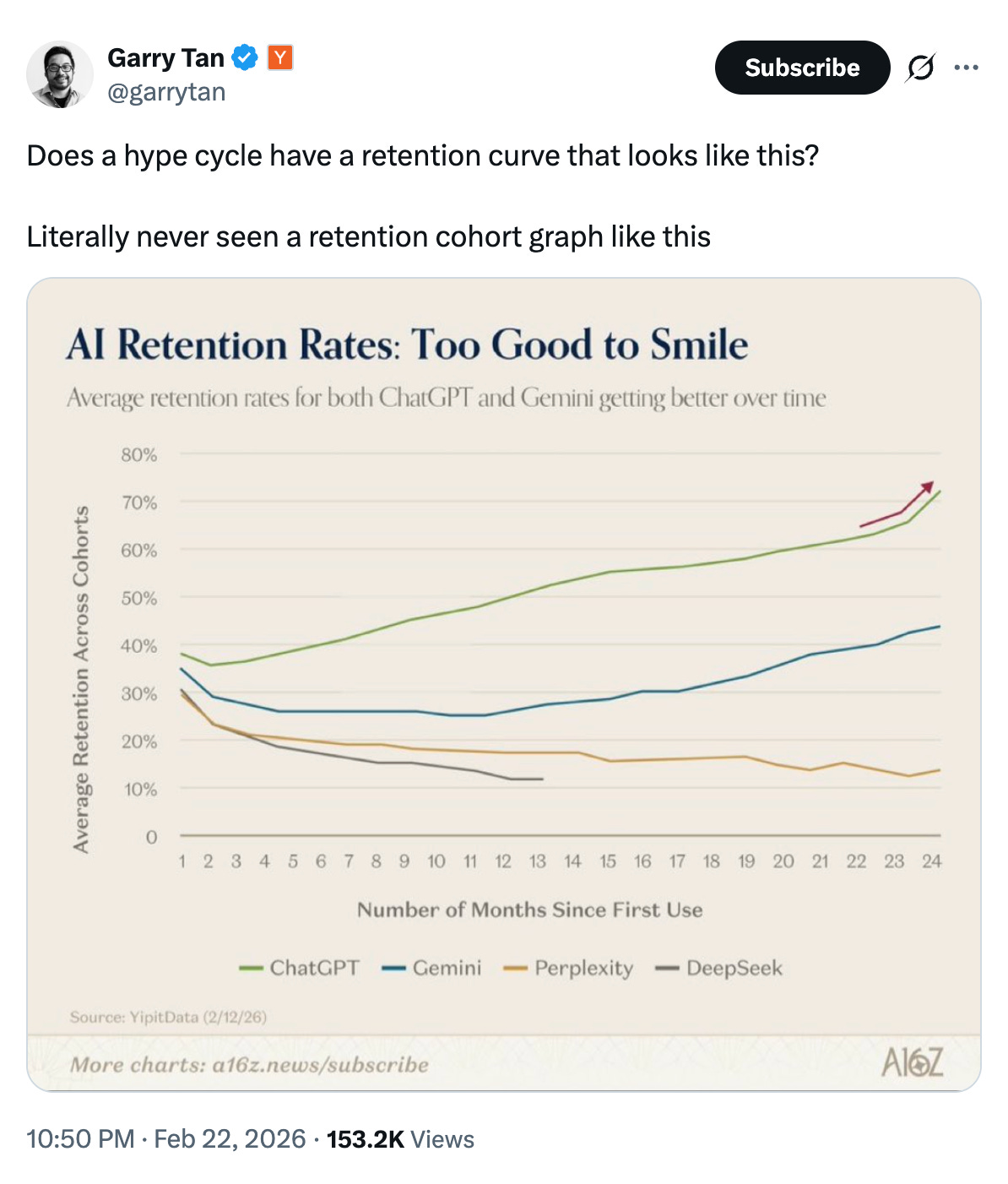
Garry Tan posted a chart showing ChatGPT’s retention curve inflecting upward and said he had “literally never seen a retention cohort graph like this.” I think he’s wrong. This pattern has shown up relatively consistently in consumer for decades in two categories:
Network effects products where retention improves as more people join: Facebook, Instagram, WhatsApp, Telegram, Figma, Notion
Personalization products that compound value over time: Duolingo’s streak mechanics, Spotify’s adaptive playlists, algorithmic for you feeds of social platforms.
ChatGPT has both. The product improves as more people use it and generate thumbs up/down data. And it has memory that makes it personal. Early cohorts show decay. Later cohorts after memory shipped show inflection. This is compounding context working exactly as designed.
Another thread to pull here: what actually matters when investing in or considering joining an early-stage consumer AI company?
Most consumer AI platforms run on subscriptions, which makes them fundamentally different from social platforms (ads) or collaboration tools (enterprise contracts). For subscription businesses, engagement depth may beat retention breadth. Would you rather back 5% retention with intensifying usage or 40% retention with passive engagement? The first converts to paid. The second churns when pricing is introduced.
4) Independent Media Is VC Backable
Media consumption is shifting. I get NYT and WSJ notifications, but most of my time is spent on newsletters, X, and LinkedIn. I will note that during the war in the Middle East, I’ve been reading way more traditional media because they still have the best breaking news coverage since they face legal liability if they’re wrong. X is just AI-generated videos of explosions.
It has put into focus the idea that people follow people, not institutions or randoms who post AI-generated content.
In the modern day, independent journalists and analysts are building real businesses. On-chain analysts, cooking creators, fermentation specialists, engineers reviewing codebases, fandom analysts doing deep-dives, travel blogs, even hyper-local content (local news, etc). Top creators can monetize through subscriptions, ads, and sponsorships while building actual trust with their audiences and highlighting the increasing importance of curation. The best ones are doing millions in revenue as solo operations or tiny teams.
I think there’s a massive opportunity to start re-bundling these independent creators together. Consumers don’t want to manage dozens of separate subscriptions, and creators are all reinventing the same operational wheel. Beyond just consolidating administrative costs, there is real value in cross-pollination of audiences and shared support staff. You could build a legitimately big media business by aggregating independent voices into a network while keeping them autonomous and giving them equity. From the journalists & analysts perspective, the capital can be used to drive significant spending on growth, expansion to other social platforms, IRL events, research, tech-enablement, human capital, and more!
It’s basically recreating media conglomerates except the talent has ownership and control because the cost burdens of distribution and reaching audiences have diminished.
5) Prof G on Young People, AI, and Fragmentation
Scott Galloway (serial entrepreneur and NYU marketing professor) is a great bridge between the last category (independent media) and the next category (covering prediction markets and issues facing young people in America). He owns his own media business and writes about issues facing young people, including the consequences of AI/tech, media fragmentation, and the rise of young founders.
We are speaking different languages. We are speaking different languages. People have different conversations in different spaces. This isn't 1960 where everybody is sitting around the living room watching Walter Cronkite. The conversation in your bubble is likely very different than the conversations other people are having.


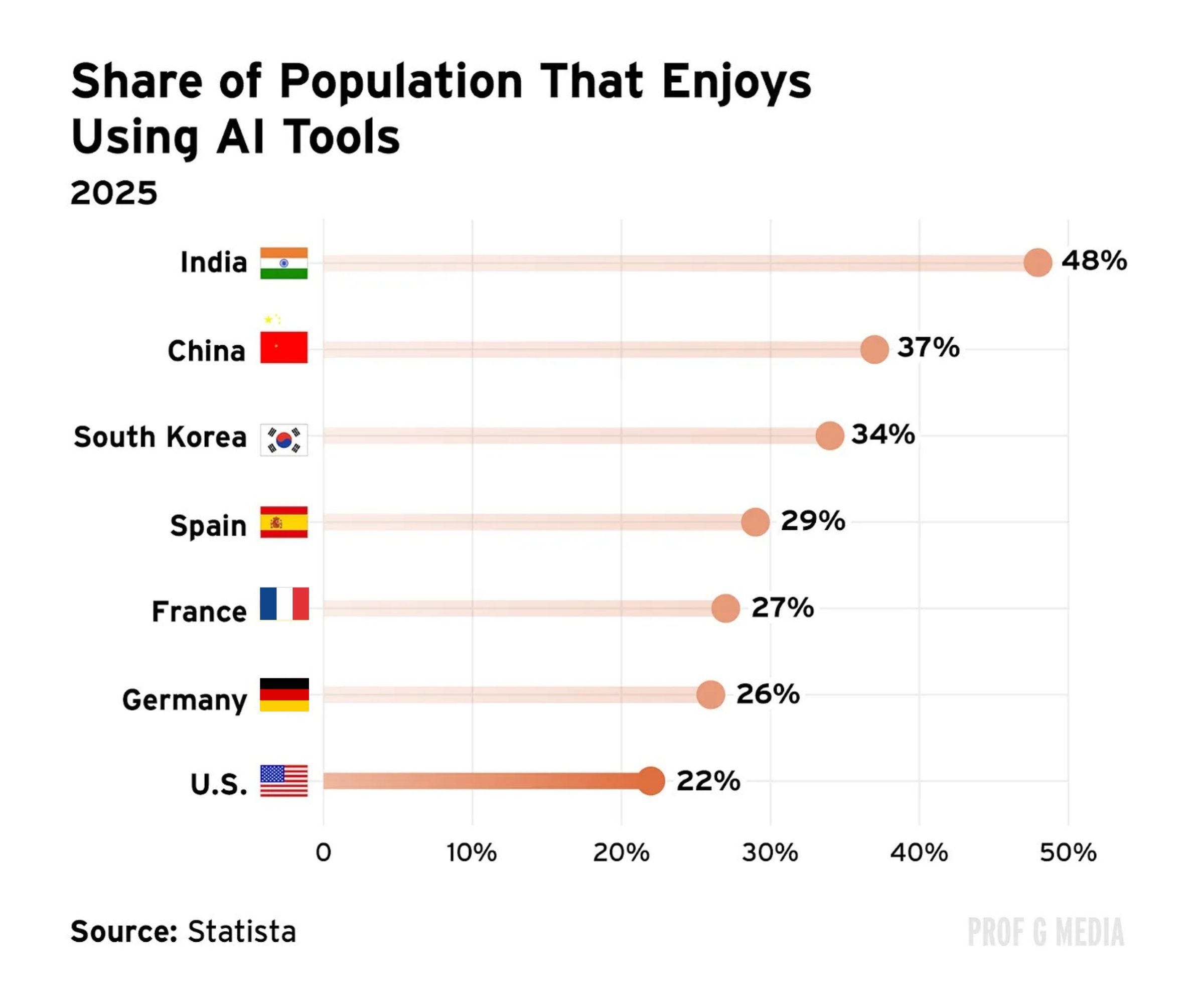
What if people hate AI? Less than 1/3 of Americans trust AI, more dislike it than like it, and 77% think it poses a threat to humanity. Across 24 states, 142 activist groups have blocked $64 billion in data center construction because locals realize data centers employ fewer people than a Walmart while sending electric bills through the roof. There is growing bipartisan resentment from Bernie Sanders to Ron DeSantis to Trump, who said this week that Big Tech companies need some “PR help” on data centers.
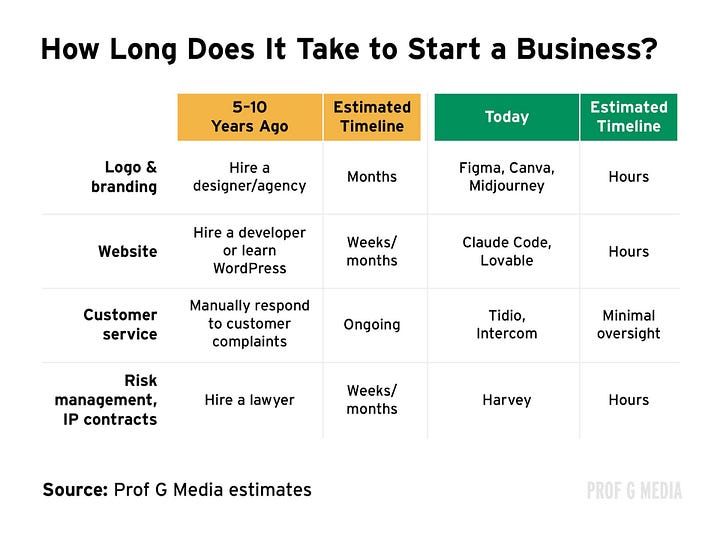
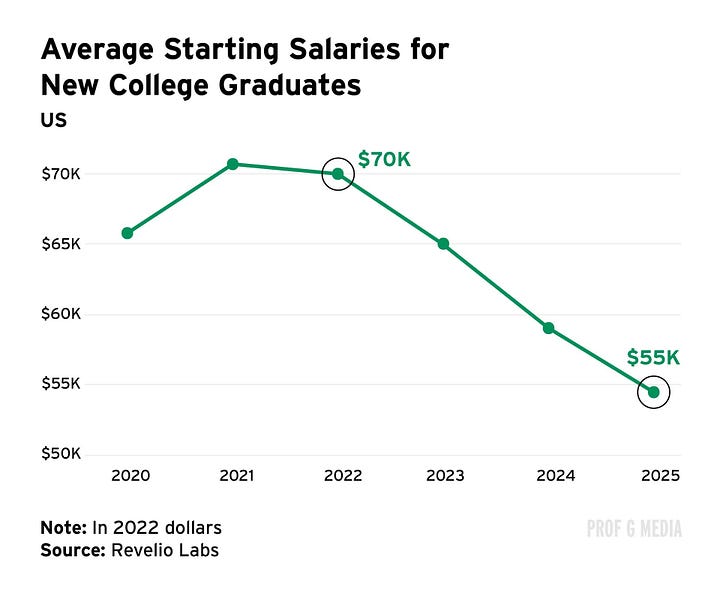
Young founder syndrome. 50% of Gen Z plan to start a business in 2026. The median YC founder is now 24 (down from 30 in 2022). New grad hiring is down 16%, real salaries (inflation adj) are down 20% since 2022. And AI levels the playing field: nobody has more than five years of LLM experience, so young people in deep have as much relevant experience as anyone. This idea does remind me of a tweet I shared a month ago from Jon Lai (a16z). He wrote that young founders pick the wrong ideas and go for safe problems (AI homework) over hard problems (AI university). Small ideas are knowable & comfortable, but you need a bigger, bolder vision to attract talent, raise money, and stay motivated.


6) Prediction Markets Are a Regulatory Arbitrage Play Disguised as Innovation
The two hottest categories for college student founders right now are dating and prediction markets. What the hell is going on?
VCs are pouring billions into Kalshi and Polymarket, both raising at $20B+ valuations. Novig just raised $75M at an $500M valuation to pivot from a peer-to-peer model to a prediction market. The pitch: asymmetric regulatory bets with insurance-like float before payouts.
I think prediction markets inevitably get cracked down on. They only work when retail gamblers subsidize sophisticated players. A similar dynamic played out with online poker in the 2000s. New players joined, got drained by sharks (“smart” money) and bots, left. Thus, every table became sharks and the market ultimately collapsed.
I also think that sports is the worst use case. Deep, liquid betting markets already exist. Kalshi markets itself as the platform where you make money off being “smart.” Young men will quietly go bankrupt thinking they’re financially sophisticated. Sports wagers are an estimated 90% of Kalshi’s volume.
The legal landscape is absurd. ESPN had a great piece this week highlighting that over 20 federal lawsuits have been filed, with Ohio and Tennessee judges issuing directly contradictory rulings on whether states can regulate. Congress is introducing bills to restrict users under 21 and ban insider trading. The CFTC says the platforms can police themselves. Many are hypothesizing that this ends up at the Supreme Court in 2027 or 2028.
On the bright side, if you love celebrity gossip or award shows, consider a hedge fund. Top funds are hiring these people en masse to price market-making positions on prediction markets. Read more from Matt Levine (Bloomberg) here.